



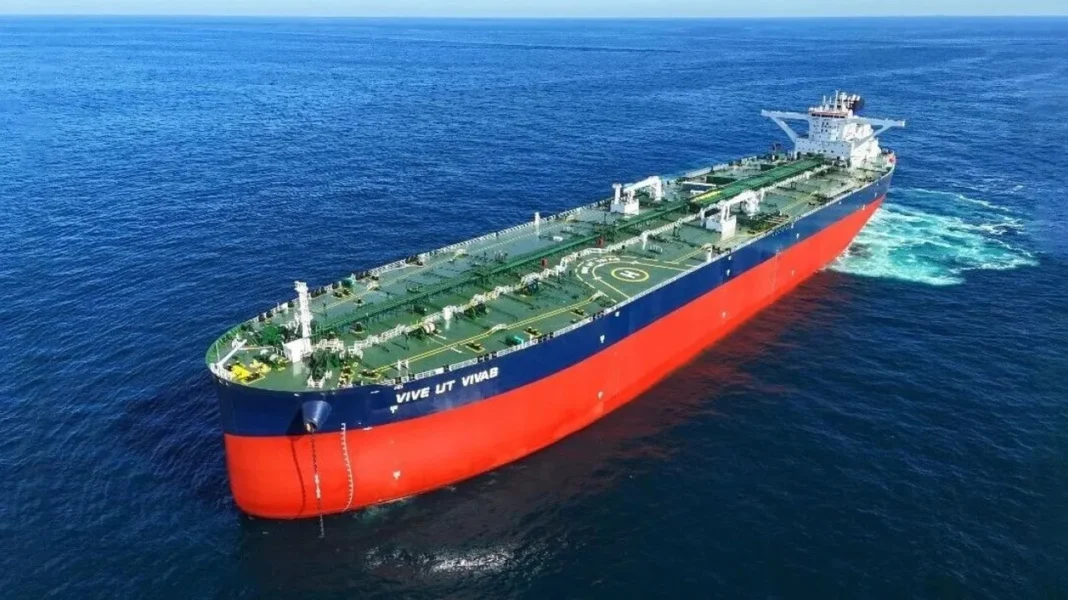


There is an old truth in shipping that every generation seems to rediscover the hard way: whoever controls the ship controls the cargo’s destiny. And right now, in a world of chokepoints, sanctions and war-risk premiums, commodity owners are rediscovering it with renewed urgency.
Look at Abu Dhabi. In early August, ADNOC Logistics & Services announced the acquisition of five modern Very Large Gas Carriers and six Very Large Crude Carriers for a combined investment of approximately USD 1.3 billion, with nine of the vessels, six VLCCs and three VLGCs, bought on the secondary market for delivery in Q3 2026 and entering service with ADNOC immediately on delivery. That followed an order the previous month for four next-generation LNG carriers worth approximately $900 million, and in late August it exercised options for two more LNG carriers from Jiangnan Shipyard for $444 million, taking its announced vessel acquisitions and newbuild commitments in 2026 to approximately $2.7 billion. The stated purpose is telling: the purchases are meant to support ADNOC Group’s integrated value chain and continued growth in production, trading and export volumes. This is a national oil company deliberately putting its own steel under its own barrels.
Another signal came just this week. On 21 September 2026, Trafigura announced a new group company, Volare Shipping, to own, operate and scale a modern tanker fleet, starting with six VLCCs on the water and eight newbuildings on order, all commercially managed by Trafigura’s own shipping business. The company is seeking around $500 million through a private placement ahead of a planned listing on Euronext Growth Oslo under the ticker “VLCC”. What makes this significant is not the size of the fleet but the shift in philosophy. Trafigura has traditionally preferred to control vessels through charters rather than own them outright, yet its head of shipping, Andrea Olivi, now says that “owning the assets is a much better value proposition.”
The context explains the conviction. The Strait of Hormuz crisis has pushed tanker freight to record highs, with daily charter rates recently crossing $1 million for the first time, as vessel supply tightens and owners hesitate to transit the Strait. Even outside the Gulf, freight has become a trading variable in its own right: chartering a tanker from Venezuela to the US Gulf Coast now costs about US$5 a barrel, up from US$1.90. When freight moves like that, a trader without tonnage is a trader without leverage.
This is precisely the dynamic I had in mind when I proposed the A.R.E.A. framework: Alliances, Relationships, Execution and Assets. The final A is Assets, and it recognises a simple reality of the geopolitical era. In times of disruption, access to physical capacity (ships, terminals, storage) becomes a strategic moat. You cannot execute on a trading opportunity if you cannot secure the steel to carry it. Commodity owners, oil companies and trading houses who own or tightly control ships today are buying optionality, security of supply and a seat at the table when capacity is rationed by risk.
So let me be clear: in the current environment, the move by cargo owners into ship ownership is rational, and in many cases smart.
But every strategy has a season. And the question that too few boardrooms are asking is: what happens to these assets when the season changes?
When the wars end, the inefficiency begins
Geopolitical disruption creates inefficiency, and inefficiency creates freight premiums. Longer routes, avoided chokepoints, sanctioned trades, floating storage and risk-averse owners all soak up tonnage and push rates up. That is the environment in which owning ships looks brilliant.
Now imagine the disruption subsides. Hormuz normalises (whatever that normal may be), the Red Sea reopens, sanctions ease, voyages shorten, and tonnage that was tied up returns to the market. Freight rates fall. At that point, the captive fleet of a commodity owner faces a structural problem
A specialist ship operator survives on efficiency. It triangulates, minimises ballast legs, combines cargoes from multiple charterers, times the market and runs its fleet like a scalpel. A captive fleet, by contrast, is built around one owner’s cargo book. Its ships are deployed first to serve the parent’s flows, often with ballast legs a third-party operator would never accept, and with employment decisions driven by internal logic rather than market signals.
This is where the real risk lies: cannibalisation. The captive ships will naturally be given the parent’s cargoes, cargoes which, in a normal market, would have gone to the most efficient operator at the lowest freight. The commodity owner ends up paying itself a higher effective freight than the market would have charged it. The ship is “employed”, the P&L of the shipping unit looks respectable on internal transfer pricing, and the inefficiency quietly migrates into the cost of the commodity.
Inefficiency does not disappear, it hides
This is the heart of my concern. In a commodity house with revenues measured in hundreds of billions, a few dollars per tonne of excess freight cost barely registers. It gets absorbed into the trading margin, netted against a good arbitrage, buried in the vast balance sheet of the commodity. No one gets fired for it, and often no one even sees it.
But inefficiency never disappears. It merely changes address. Eventually, every extra cost in the supply chain, whether an unnecessary ballast leg, an under-utilised ship or an over-market freight rate charged internally, finds its way into the delivered price of the commodity. And in most cases, it is the final consumer who pays: at the petrol pump, in the electricity bill, in the price of steel and the things built from it.
So while the idea of oil companies and traders owning ships is sound in a crisis, they must remain vigilant that their inefficiency does not hide in the larger commodity balance sheet.
The Valemax lesson
We have seen this film before, and the ending is instructive.
The Valemaxes were designed to cut the cost of shipping ore from Brazil to China, helping Vale compete with Australian rivals sitting much closer to the biggest market. Technically, the 400,000 dwt concept was brilliant. Vale ordered twelve of them from Rongsheng in 2008 and seven more from Daewoo in 2009, with further similar ships built for other owners and chartered to Vale on long-term contracts.
What followed was a lesson in what happens when a cargo owner steps into the shipowner’s arena. When the first Valemax called at Dalian in December 2011, the China Shipowners’ Association pushed back hard, citing safety and port standards and accusing Vale of trying to monopolise the seaborne iron ore trade to China. By September 2014, a Valemax had called at a Chinese port only twice, and the ships were forced into floating transhipment in Malaysia or the Philippines, which effectively wrecked the business model behind them.
The resolution came when Vale handed the steel back to shipowners. Vale sold four VLOCs to Cosco for $445m under an agreement in which Cosco would also build and operate ten VLOCs on a 25-year COA, and similar arrangements followed with China Merchants. By December 2017, Vale had sold all 19 of the Valemaxes it owned, in line with a strategy of strengthening its balance sheet and focusing on core assets.
Note what happened: the ships did not disappear. The concept did not fail. The Valemaxes still sail today. What changed was who owned and operated them. Vale retained control of its logistics through long-term contracts of affreightment, while the ownership, operation and market risk moved to shipping companies. That, to me, is the enduring lesson: it is best to let shipping companies and experts do what they are experts in, which is shipping the cargo.