





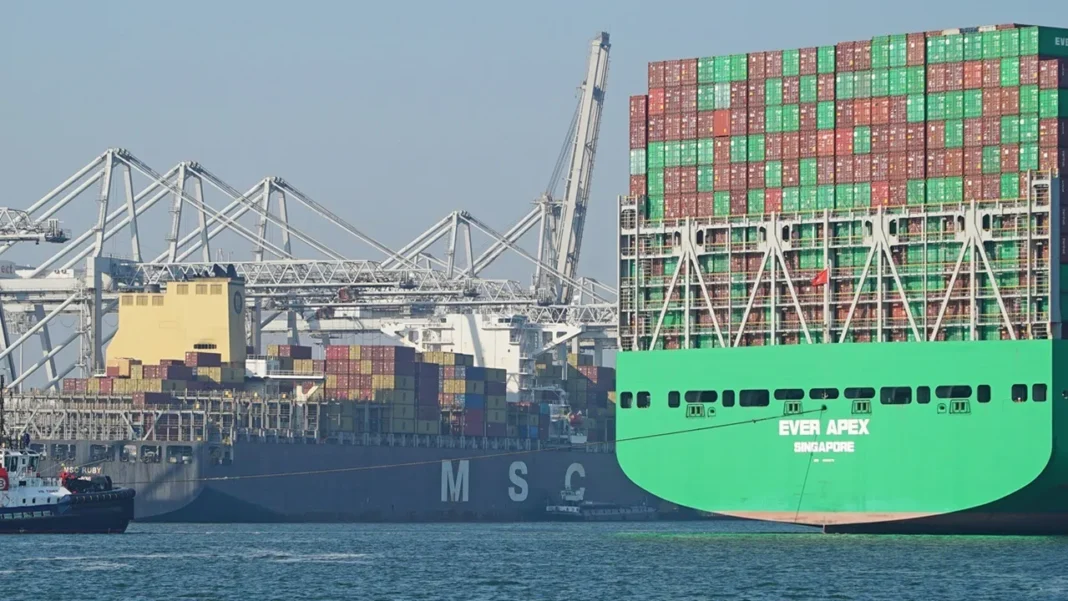


Declining Asia to Europe container spot rates from July bottomed out at the end of September and have been edging upwards even through the Golden Week pause and accelerated return to the Red Sea and Suez Canal route.
Spot rates from the Far East to North Europe and the Mediterranean increased 6.8 and 5.8% respectively week-on-week, settling at $3,698 per feu and $4,442 per feu, according to Xeneta data.
Increased rates into Europe come even as the return of capacity to the shorter Red Sea and Suez Canal route, eases capacity shortages.
This is a conundrum because the release of capacity into the global fleet should ease pressure on rates, but we are seeing the opposite. Spot rates are still up 67% into North Europe and 33% into Mediterranean compared to pre-Hormuz crisis on 28 February,” said Xeneta’s Chief Analyst Peter Sand.
The answer, in part, according to Sand is the strong demand for goods into Europe, which increased 12.2% in the first seven months of this year compared to the similar period in 2025.
Drewry Shipping Consultants report that even in the face of this increased demand carriers have increased the number of cancelled services from two last week to eight over the course of this coming week,
“Carriers are reducing capacity via blank sailings to put upwards pressure on freight rates,” noted Drewry in its weekly rate report.
Moreover, vessel delays at Shanghai have more than halved, said the consultant, with average vessel waiting times declining from 97 hours to 42 over the week.
Disruption such as Middle East conflict brings volatility and sudden shocks, but demand is a powerful upward force for rates. If demand is not there, then rates will collapse, but it has been strong enough on the European fronthauls to prevent this, even as Red Sea capacity returns,” said Sand.
Spot rates on the Pacific on headhaul trades remain high, but flat, rising just 0.2% to both the US West and East Coasts. Even so the rates remain elevated at $8,311 per feu to the West Coast and $11,525 per feu to the East Coast, up 342 and 335% since February respectively.
Increases in demand on the Pacific appears to have flattened with rates levelling out, still the carriers have cancelled two more sailings this week, though that is a decrease on the six blanked sailings over the past week.
“The East-West container freight market remains uncertain. Security risks and attacks on ships continue to affect vessel movements through the Gulf,” said Drewry’s. the report added, “Transpacific rates continue to receive support from US import demand, while carriers are attempting to sustain Asia–Europe rates through capacity management and surcharges.